Glamiss and Candor's Rebellion Alliance
The KillerGlamiss and Candor's Rebellion Alliance begins as a shared denunciation of Duncan and quickly becomes a concrete bargain for power. Glamiss and Candor present themselves as allies against a ruler they call tyrannical, but the grounds they give include Duncan’s interference with Glamiss’s land and his recruitment of Glamiss’s men. Their compact culminates in an agreed military timetable and an equal division of the throne, making the alliance at once a revolt against Duncan and a plan to replace him with two co-rulers.
Formation and Grievances
Glamiss and Candor address one another formally as Baron Candor and Baron Glamiss before Glamiss turns from greeting to business. Their exchange is structured as agreement: one calls for the other to listen, and both conclude that the existing situation cannot continue. The brisk call-and-response establishes a united front, though the grievances that follow are especially specific to Glamiss.
Glamiss objects that Duncan hunts on his land. Candor answers that Duncan does not hunt on his, and Glamiss likewise says that the practice does not affect him personally. The difference matters: the complaint is not presented as a shared injury to both estates. Instead, Candor’s contribution is to affirm Glamiss’s objection and join the larger opposition. Their agreement thus begins through solidarity with a partner’s grievance, not through a claim that every part of Duncan’s conduct has harmed each baron equally.
The dispute over the army sharpens that distinction. Glamiss says Duncan is drafting his men into the army; Candor names it the National army. Candor then observes that if men are prepared to accept such service, that is their business, while Glamiss’s complaint remains focused on Duncan taking his men. The exchange exposes a practical tension inside the alliance: both oppose Duncan, but the immediate cost they emphasize is the loss of Glamiss’s control over his own land and retainers. Their rebellion gathers separate interests beneath a common target.
Shared Opposition and Its Limits
Their resolve is expressed in increasingly emphatic repetition. Candor says Duncan must be got rid of; Glamiss expands the formulation to getting rid of him lock, stock, and barrel, and Candor echoes the phrase. This shared language turns their complaint into a declared objective: the problem is not to persuade Duncan or limit one disputed practice, but to remove him altogether.
The dialogue also makes their mutual understanding sound personal as well as political. Candor says Duncan haunts him even in dreams, and Glamiss describes him as a living nightmare in his own dreams. These statements give their opposition an image of persistence beyond the immediate conversation. Yet the scene supplies no detailed account of how Duncan has affected Candor’s life beyond this expression of persecution; the stronger material basis for the alliance remains Glamiss’s land and men.
The Bargain for Rule
Removal of Duncan leads directly to the question of succession. Glamiss says that Duncan’s holdings will be divided between them, and Candor specifies half and half; Glamiss repeats the equal division. They then agree that they will reign in Duncan’s place. The terms are unusually plain: no broader settlement or political program is described, but the intended distribution of power is explicit and equal.
This proposed equality makes the alliance more than a temporary agreement to fight a common enemy. The two barons imagine themselves as joint beneficiaries of victory, with the throne itself treated as something they can divide. Their shared condemnation of Duncan and their promise of an even split coexist without apparent dispute in the exchange. The partnership is therefore cohesive in its immediate aim, while its basis is also transparently material: Duncan’s removal is to give both men a share in rule.
Banco and the Military Plan
As Glamiss and Candor walk toward one another, they look toward the entrance of Banco and greet him with elevated military praise, calling him a gallant general and a great captain. This entrance places Banco in the scene at the moment the two barons have established their agreement. The exchange records their welcome but does not, by itself, establish that Banco has accepted their plan or joined the alliance.
Glamiss then converts the pact into preparations for war: they are to polish their weapons, gather their men, and prepare their armies. He names dawn as the time of attack and predicts that Duncan will be beaten by the following evening, after which the two barons will share the throne. The compressed timetable gives the conspiracy a practical sequence—armament, assembly, assault, victory, division of power—while the assured forecast of success belongs to Glamiss’s declaration, not to a confirmed outcome.
Rhetoric, Trust, and Political Self-Justification
The exchange closes by testing whether Candor shares Glamiss’s stated political rationale. Candor asks whether Glamiss truly believes Duncan is a tyrant. Glamiss answers with a cascading list of condemnations, then offers Duncan’s possession of power as proof. He insists that his motives are honorable because he would otherwise have no reason to depose Duncan. The reasoning does not independently demonstrate tyranny; it reveals how readily Glamiss turns the fact of Duncan’s rule into justification for overthrowing him.
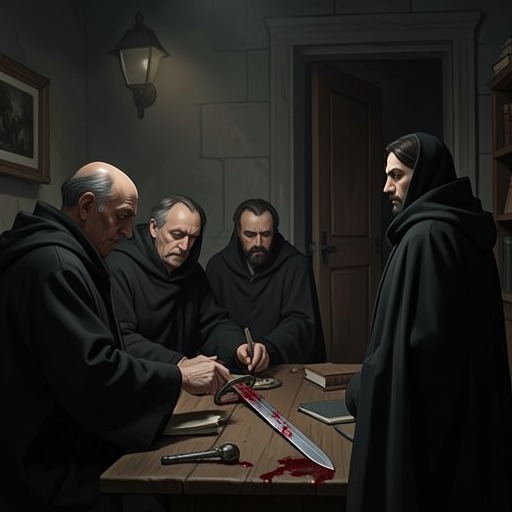
That certainty sits beside a sign of unease between the conspirators. Glamiss puts a hand on his sword and warns Candor not to try anything; Candor responds with repeated assurances that he will not and that Glamiss can count on him. The scene does not show a break in their agreement, and they proceed to plan the attack. It does, however, place a threat and a pledge of loyalty within the same partnership. Their alliance is united against Duncan and explicit about sharing the throne, yet its immediate assurance rests on force, repeated promises, and the advantage both expect to gain.